
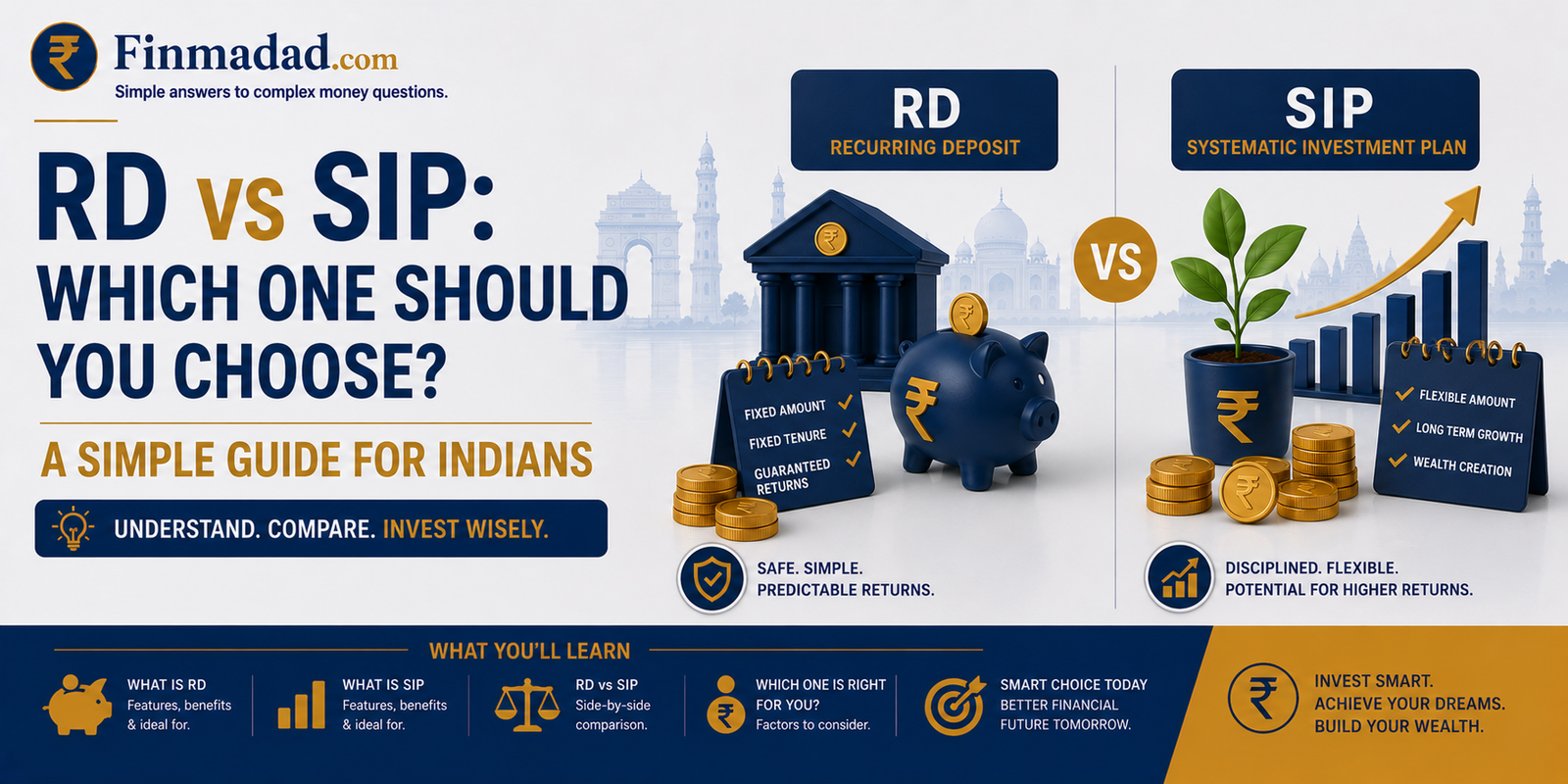
Let me start with something most people get wrong.
The question is never “RD vs SIP: which is better?” That is the wrong question. The right question is: what is your goal, and how long do you have?
Once you answer that, the choice becomes obvious. Let me break it down.
What is an RD?
RD stands for Recurring Deposit. You deposit a fixed amount every month with your bank or post office, for a fixed period, and at the end you get your money back with interest.
Simple. Predictable. No surprises.
Right now, most banks are offering RD interest rates between 6% and 7% per year. Post office RDs are in a similar range. Senior citizens usually get a slightly higher rate — typically 0.25% to 0.50% extra.
What RD guarantees you?
Your principal is completely safe. The interest rate is locked in at the time of opening. You know exactly how much you will get at maturity down to the last rupee. There is no market risk, no volatility, no bad months.
What RD does not guarantee you?
Wealth creation. At 6 to 7% returns, you are barely keeping pace with inflation — India’s average inflation has historically been around 5 to 6% per year. So in real terms, your money is either staying flat or growing very slowly. You are preserving value, not building it.
That is not a criticism of RD. That is simply what RD is designed to do and it does it well.
What is a SIP?
SIP stands for Systematic Investment Plan. And here is something important that many people misunderstand: SIP is not a product. It is a method.
SIP is simply the habit of investing a fixed amount every month into a mutual fund. The mutual fund is the actual product. SIP is just how you invest in it regularly, automatically, without having to time the market.
When you start a SIP in an equity mutual fund, your money gets invested in a basket of stocks — large companies, mid-sized companies, or a mix depending on the fund you choose. As those companies grow over time, your investment grows with them.
What SIP can deliver?
Historically, diversified equity mutual funds in India have delivered returns of 10% to 12% CAGR over long periods 10, 15, 20 years. Some funds have done better. This is not a guaranteed number it is what history shows. The past does not guarantee the future, but it is the best reference point we have.
What SIP does not protect you from?
Short-term losses. In the short run 1 year, 2 years, sometimes even 3 years — equity markets can fall. Your SIP portfolio value can go negative for a period. If you panic and stop your SIP during a market fall, you lock in those losses and miss the recovery. SIP works best when you stay invested through the ups and downs.
The Real Difference: Safety vs Growth
| RD | SIP (Equity Mutual Fund) | |
|---|---|---|
| Returns | 6–7% (fixed) | 10–12% (historical, not guaranteed) |
| Risk | Zero — principal fully safe | Market risk — can fall in short term |
| Inflation beating | Barely | Yes, over long term |
| Wealth creation | Not designed for it | Yes, over long term |
| Best for | Short-term, certain goals | Long-term goals |
| Where | Bank or Post Office | Mutual fund via app or AMC |
| Tax | Interest taxed as per slab | LTCG at 12.5% after 1 year (equity) |
So When Should You Choose RD?
Choose RD when your goal is near and the money must be there — no matter what.
Emergency fund: Your 3 to 6 months of expenses that you keep for job loss, medical emergencies, or unexpected bills. This money cannot be in the market. RD or a liquid fund is the right place for it.
Short-term goals within 1 to 3 years: Planning to buy a phone, a two-wheeler, a laptop, or going on a trip next year? RD is perfect. You need the money at a specific time, and you cannot afford market risk eating into it right before you need it.
Conservative investors who cannot sleep with market risk: There is no shame in this. If watching your portfolio go red causes you genuine anxiety, RD gives you peace of mind. That peace of mind has real value.
Retired individuals or those near retirement: When your income is fixed and you depend on your savings, capital protection matters more than growth. RD and other fixed-income instruments belong in this stage.
So When Should You Choose SIP?
Choose SIP when your goal is far enough away that time can work in your favour — and you can ride out market volatility without panic.
Retirement: If you are 30 years old and planning to retire at 60, you have 30 years. Even if markets fall badly in year 5 or year 15, history shows they recover. A ₹5,000 monthly SIP at 12% CAGR over 30 years becomes approximately ₹1.76 crore. The same ₹5,000 in an RD at 6.5% over 30 years becomes approximately ₹57 lakh. The difference is enormous.
Children’s education: School fees are predictable. University fees 15 years from now are not — they will be significantly higher than today due to inflation. SIP gives your money a chance to grow faster than that inflation.
Children’s marriage: Weddings in India are expensive and getting more expensive. If your child is young today, you have 15 to 20 years. SIP is the right tool.
Any goal that is more than 5 years away: The general rule of thumb — if you need the money in less than 3 years, avoid equity. If your goal is 5 or more years away, equity SIP is worth considering seriously.
Can You Do Both?
Absolutely — and for most people, the answer is not RD or SIP. It is RD and SIP, for different purposes.
A practical approach that works for most salaried Indians:
Keep 3 to 6 months of expenses in an RD or savings account as your emergency fund. This is untouchable.
For every other goal, ask yourself: when do I need this money? If the answer is within 3 years, use RD or a short-term debt fund. If the answer is beyond 5 years, SIP in equity mutual funds is likely the better tool.
One Common Mistake to Avoid
Many people start a SIP for a short-term goal — say they want to buy a car in 2 years — and then are shocked when the market falls and their portfolio is down 15%. They redeem at a loss and swear off mutual funds forever.
The fault was never the SIP or the mutual fund. The fault was using the wrong tool for the goal.
Match your tool to your timeline. That is the entire framework.
Quick Summary
Choose RD when: goal is within 1–3 years, money must be safe, or you need an emergency fund.
Choose SIP when: goal is 5+ years away — retirement, children’s education, children’s marriage, or any long-term wealth creation goal.
Use both: RD for safety and liquidity, SIP for long-term growth. Most Indians need both in their financial life at the same time.
I am not a SEBI registered advisor — just sharing what I have learnt managing my own money. For personalised advice based on your situation, speak with a qualified financial advisor.